

Beginner’s Mind, Better Work
AI won’t just change what you produce. It will change how you show up.

Here’s a confession. I’ve been working for over three decades — coaching leaders, writing books, designing retreats, building a consulting practice from scratch. I have systems. I have workflows. I have habits so deeply ingrained in my daily rhythm that I could run most of my workweek on autopilot.
And that, it turns out, was the problem.
When I started working seriously with AI — not just dabbling, but actually restructuring how I operate — something uncomfortable happened. I discovered that the systems I’d been running for years weren’t just familiar. Some of them were quietly broken. They had been for a while. I just couldn’t see it because I was inside them. It took a machine to show me what I’d been too practiced to notice.
The Zen of Not Knowing
There’s a line from Shunryu Suzuki — the Zen teacher who brought mindfulness practice to the West: “In the beginner’s mind there are many possibilities; in the expert’s mind there are few.”
That one sentence describes exactly what AI is asking of every leader and knowledge worker right now. Not a technology upgrade. A posture change. A willingness to approach your own work — the work you’ve been doing for years, maybe decades — as if you’ve never done it before.
In Zen, this is called shoshin — beginner’s mind. An attitude of openness, eagerness, and lack of preconceptions, even when studying at an advanced level. The mind of the beginner is empty, free of the habits of the expert, ready to accept and open to all possibilities.
Most of us, and I include myself, approach AI with an expert’s mind. We integrate it into our existing workflows. We ask it to do the things we already do, just faster. And then we wonder why the transformation feels so incremental.
The real revolution isn’t AI doing your work faster. It’s AI revealing that the way you were working was never the best way to begin with.
Breaking the Inertia
Let me get specific, because I think the abstract conversation about AI and work is getting stale. Here’s what actually happened in my practice.
I used to spend a significant chunk of my week on what I’d call production work. I assembled decks, formatted documents, drafted proposals, and built out program materials, to name a few. I was good at it. I had templates. I had a rhythm. It felt productive because I was always doing something. But productive and valuable aren’t the same thing.
Now I spend more of my time directing AI agents than just about anything else I do. And here’s the honest part — I sometimes find myself struggling to keep them busy. Not because there isn’t work to do, but because I don’t yet have the system for orchestrating this kind of work. My old system was built for a solo practitioner. The new reality requires me to think like someone managing a team of very fast, very capable collaborators who never get tired.
That shift — from doer to director — is the first piece of inertia that has to break. And let me tell you, it doesn’t break quietly. It cracks.
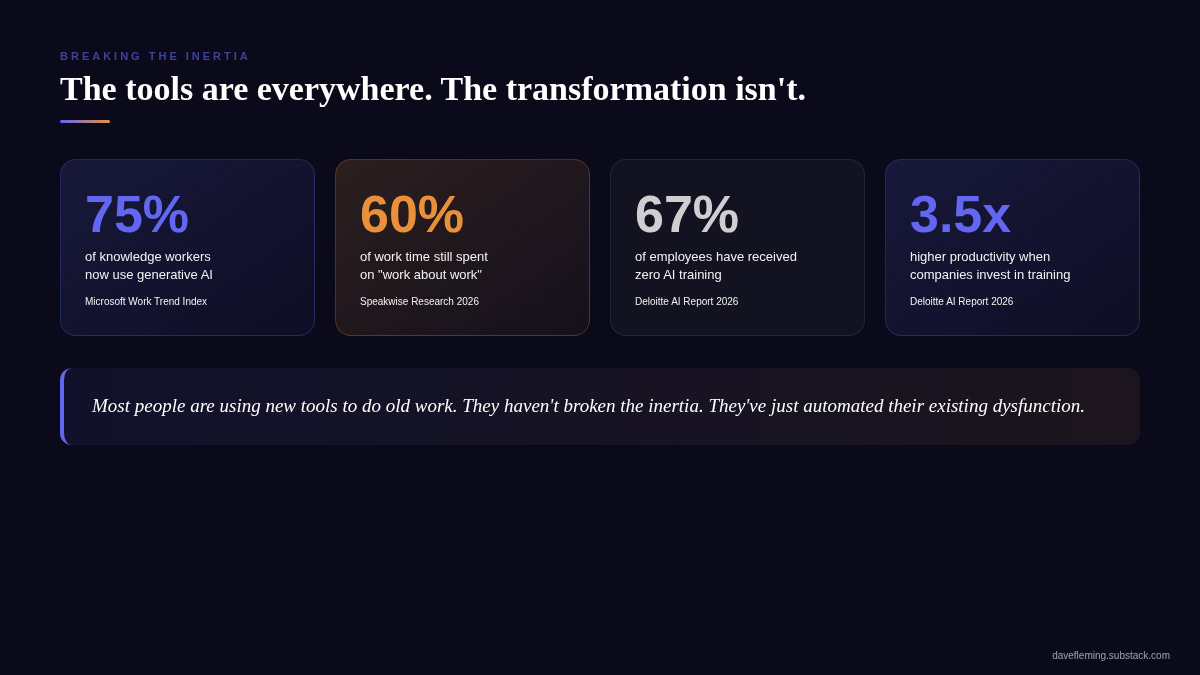
The data tells us the tools are everywhere. But here’s what the data doesn’t show: most people are still using new tools to do old work. They haven’t broken the inertia. They’ve just automated their existing dysfunction.
The Taste Test
Here’s a way to know if you’ve actually changed how you work, or if you’ve just added a shinier layer on top of the old pattern. It should feel different.
I mean, fundamentally, unmistakably different. Like the difference between chocolate volcano cake and kale in your mouth. No one is ever going to confuse those two experiences. And if your “AI-transformed” workday feels roughly the same as it did eighteen months ago — same rhythms, same types of tasks, same distribution of your energy — you haven’t crossed the threshold yet. You’ve just redecorated the room.
When the change is real, you feel it in your day. You’re developing more. Creating more. Spending time on things that actually create value in your mission instead of servicing the machinery around it.
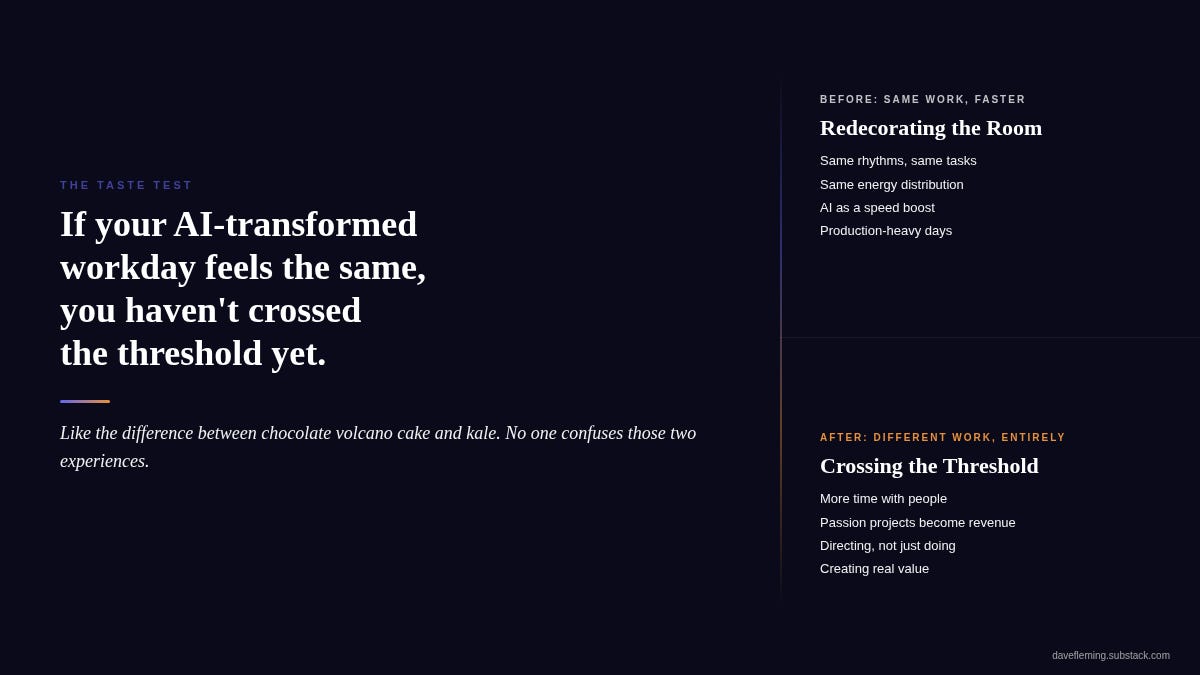
For me, one of the clearest signals is time with people. I’m spending more time in real conversation with the leaders I serve — not less. The AI handles the production layer, so I can bring my full attention to the human layer. That’s not a small shift. That’s a fundamental reorientation of my work.
And here’s the part that surprised me: I’m also taking passion projects — things I’d been thinking about for years but never had the bandwidth to build — and turning them into real, revenue-generating parts of my business. Ideas that lived in notebooks are becoming products. Not someday. Now.
AI should both revolutionize and liberate how you work. If it’s only doing one, you’re leaving half the transformation on the table.
The Art of Experimentation
Here’s where the beginner’s mind becomes practical.
When I started this shift, I didn’t have a grand strategy. I had curiosity and a willingness to try things. I experimented constantly. I tried different tools, different workflows, and different ways of prompting and directing AI agents. Some of it worked brilliantly. A lot of it didn’t. That’s the point.
The biggest mistake I see leaders making with AI is expecting it to work the first time perfectly, and then getting frustrated when it doesn’t. That frustration is the expert’s mind talking — the part of you that’s used to being competent, used to knowing the answer, used to things working the way they’ve always worked.
But here’s what I’ve learned: the model you’re working with — whatever model it is — is a partner. Not a vending machine. You’re growing together in how you work together. The first draft is never the final product, just as the first conversation with a new team member is never the deepest.
So push it. See how far you can take it. Ask it to help you think, not just produce. When it gets something wrong, don’t quit — redirect. The people I see getting the most out of AI are the ones who treat it the way a good leader treats a talented but new team member: with patience, high expectations, and the understanding that the relationship improves over time.
The Conductor, Not the Soloist
There’s a concept emerging in organizational design that I find compelling: human-on-the-loop orchestration. The idea is that the most effective knowledge workers of the next era won’t be the ones who do the most. They’ll be the ones who direct the most, thinking more like a conductor of workflows than a solo performer.
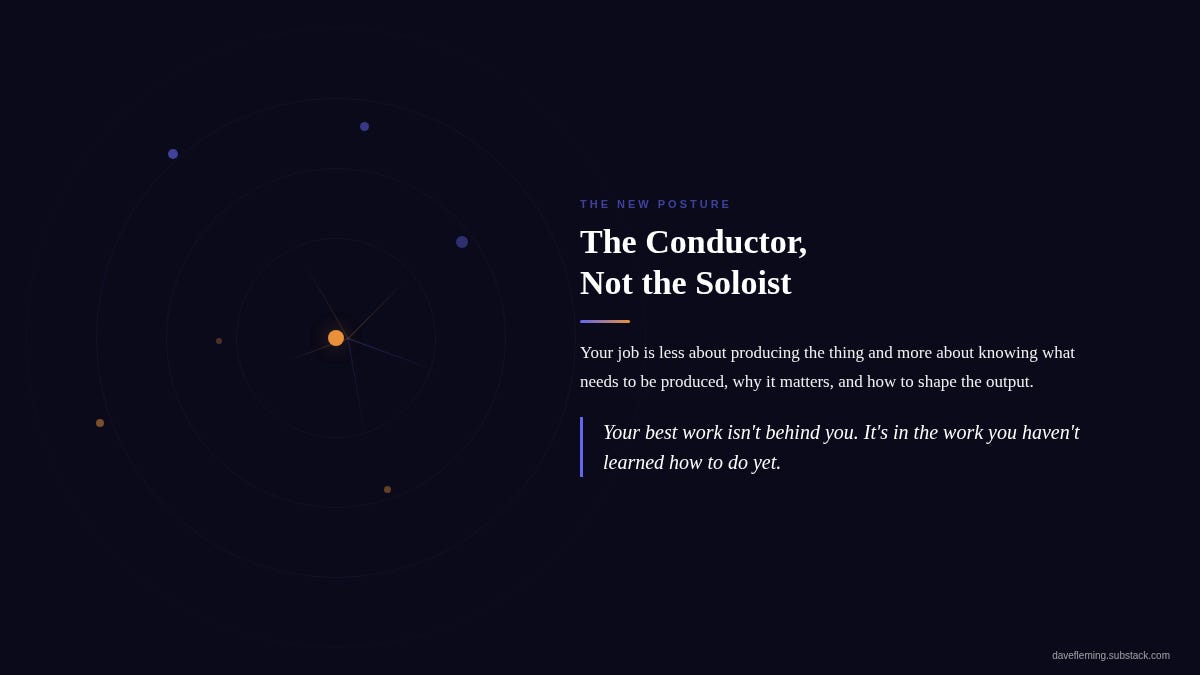
I feel this in my own work every day. My job is less about producing the thing and more about knowing what needs to be produced, why it matters, and how to shape the output so it carries the insight and care that my clients and readers deserve. The judgment, the taste, the human discernment — that’s what I bring. The velocity comes from somewhere else now.
And that requires a kind of emptying out. A willingness to let go of the identity you built as the person who does the work, and step into the identity of the person who shapes the work. That’s a threshold. And like all thresholds, it’s uncomfortable.
Begin Again
Here’s what I want to leave you with. The Zen tradition doesn’t talk about transformation as a one-time event. It talks about it as a practice — something you do every day, every moment. You begin again. And again. And again.
That’s exactly what this moment asks of us. Not one big shift, but a daily willingness to approach your own work with a beginner’s mind. To notice the patterns that aren’t serving you anymore. To experiment without needing to be good at it yet. To accept that the discomfort you feel isn’t a sign that something is wrong — it’s a sign that something is finally changing.
The inertia of how you work is the last barrier standing between you and the kind of contribution you’re actually capable of. AI didn’t create that barrier. But it might be the thing that finally makes it visible. And once you see it, you can’t unsee it. So begin again. Empty the cup. Let the beginner’s mind show you what the expert’s mind has been hiding. Your best work isn’t behind you. It’s in the work you haven’t learned how to do yet.
References:
75% of knowledge workers now use generative AI Microsoft Work Trend Index: AI at Work Is Here
60% of work time still spent on “work about work” Knowledge Worker Productivity Statistics 2026 — Speakwise
67% of employees have received zero AI training AI in the Workplace Statistics 2026 — Azumo
3.5x higher productivity gains when companies invest in AI training What Do the Best AI Productivity Reports Reveal in 2026 — UC Today
85% of AI users say it helps them focus on important work Microsoft Work Trend Index: AI at Work Is Here
59% faster task completion for writing with AI 49 Statistics on AI in the Workplace 2026 — Work Insiders
33% of enterprise apps will include AI agents by 2028 Unlocking Exponential Value with AI Agent Orchestration — Deloitte